
Fire Dampers
Fire dampers are life-safety devices installed where ductwork passes through fire-rated walls, floors and partitions. In normal operation they sit open and let air flow freely; in a fire, a fusible link rated at 72°C melts and the damper snaps shut automatically, maintaining the integrity of the fire compartment and stopping fire spreading through the duct. Alpha Air supplies mechanical fire dampers for both rectangular and circular ductwork, plus intumescent fire blocks for grille and transfer openings.
Rectangular, Circular and Intumescent Options
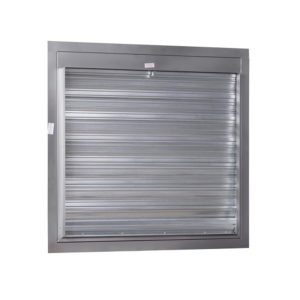
- Rectangular fire dampers — steel curtain-type dampers, made to measure to your exact width × height with instant online pricing. Fire classification E120 to BS EN 1366-2 / BS EN 13501-3, manufactured to the BS EN 15650 product standard, with a choice of Angle Frame (AF) or HEVAC frame and galvanised or 430-grade stainless steel construction.
- FD-C circular fire dampers — single-blade dampers for spiral and circular duct, in nominal diameters from 100mm to 315mm, achieving ES120 in blockwork/masonry walls and concrete floors. Each includes a handy manual volume-control facility for balancing airflow.
- Intumescent fire blocks — square blocks from 150mm × 150mm up to 500mm × 500mm that expand under heat to seal an opening.
Fire Damper or Fire & Smoke Damper?
A standard fire damper is fully mechanical — no wiring, no actuator — and responds to heat via its fusible link. If your fire strategy also calls for smoke control, protection of escape routes, or closure on a signal from the fire alarm, you need a motorised fire & smoke damper with a spring-return actuator instead.
Every made-to-order damper shows its lead time on the product page, stocked items ordered by 3pm ship next day, and UK mainland delivery is free on orders over £400 ex VAT. If you are unsure which damper your project needs, our Leicester-based team is happy to talk it through on 0116 246 0031.


What Is a Fire Damper?
A fire damper is a passive fire protection device installed inside a duct at the point where it passes through a fire-rated wall, floor, or ceiling. Its sole purpose is to prevent fire and hot gases from travelling through the ductwork from one fire compartment to another. In normal operation the damper blade is held open, allowing unrestricted airflow. When a fire raises the local temperature to 72°C, the fusible link melts and a spring-loaded blade snaps shut, sealing the duct opening and preserving the fire integrity of the barrier.
Regulations and Standards
UK Building Regulations Approved Document B (Fire Safety) requires fire dampers wherever ductwork penetrates a compartment wall or compartment floor. The relevant product standard is BS EN 15650, which defines testing, classification, and CE marking requirements for fire dampers. All fire dampers we supply carry CE marking and third-party certification.
Under the Regulatory Reform (Fire Safety) Order 2005, building owners and responsible persons have a legal duty to ensure fire dampers are correctly installed, accessible for inspection, and tested at regular intervals.
Circular vs Rectangular Fire Dampers
Circular Fire Dampers
Designed for spiral (round) ductwork. They feature a cylindrical casing with spigot ends that connect inline with the duct. Available in sizes from 100 mm to 630 mm diameter. Circular fire dampers are the most common type in spiral duct systems.
Rectangular Fire Dampers
For rectangular ductwork or where the duct penetration is through a rectangular builder’s opening. Available in a wide range of width-by-height combinations. Multi-blade designs with interlocking blades are used for larger sizes to ensure a complete seal.
Installation Requirements
- The damper must be installed within the thickness of the fire-rated barrier, or immediately adjacent to it with fire-rated wrapping extending from the barrier to the damper
- An access panel must be fitted in the duct or ceiling adjacent to every fire damper to allow inspection, testing, and reset
- The damper casing must be securely fixed to the structure, independent of the ductwork
- Follow the manufacturer’s installation instructions precisely — incorrect installation voids the certification
Testing and Maintenance
Fire dampers should be inspected and drop-tested annually as part of the building’s fire risk assessment. Testing involves triggering the blade release mechanism, verifying full closure, and resetting the damper. Records must be maintained and made available to the fire authority on request.
Why Choose Alpha Air?
Alpha Air supplies CE-marked fire dampers from BSB and other trusted UK manufacturers, backed by many years of industry expertise. We stock popular circular sizes for same-day dispatch and can supply rectangular dampers to order with short lead times. Our team can advise on specification and Building Regulations compliance — call 0116 246 0031.
Frequently Asked Questions
What size fire damper do I need?
The fire damper diameter must match your ductwork size. For circular ductwork, order the same diameter damper as your spiral duct. For rectangular ductwork, specify the width and height of the duct or the builder’s opening. Contact us on 0116 246 0031 if you need help selecting the correct size.
Do fire dampers need access panels?
Yes. Every fire damper must have an adjacent access panel to allow annual inspection, testing, and resetting. This is a regulatory requirement. The access panel should be positioned so the damper blade, fusible link, and reset mechanism are all reachable.
How do I reset a fire damper after it has been triggered?
After activation the fusible link must be replaced with a new one, and the blade manually reset to the open position. The exact procedure varies by manufacturer — refer to the installation manual supplied with the damper. Never bypass or cable-tie a fire damper blade open.
Are your fire dampers CE marked?
Yes. All fire dampers we supply are tested to BS EN 15650, carry CE marking, and are accompanied by a Declaration of Performance. This is a legal requirement for fire dampers placed on the UK market.